About Us
Chrysalis Group comprises both commercial and not-for-profit organisations operating in the specialist supported housing, support, and care sectors. The Group’s expertise is widely recognised as a leader in the field. We adopt a customer-focused, tailored approach to scheme funding, investment, design, development, and operational delivery, ensuring robust viability and strategic governance are aligned with the Group’s focus on social impact, focused investment, and our joint commercial and charitable goals.
Outline of Chrysalis Group Services
Chrysalis provides safe, individually designed, independent, structured accommodation to those who need access to appropriate care, support and/or treatment. The Group’s service providers and partners provide support and care for people with learning disabilities, autism, physical disabilities, and acquired brain injury, as well as for the rehabilitation of offenders with challenging support needs, addiction recovery support, domestic abuse, homelessness prevention, and mental health services, delivered within our specialist, structured supported homes or targeted support settings.
We have collectively provided these services for over 24 years and have extensive experience helping people who are vulnerable and have challenging, complex life experiences that are often not well supported or under-supported within mainstream settings.
Chrysalis Group operates across the Full Development Lifecycle, spanning Funding, Investment, Design, Construction, and Specialist Operational Management. We work closely with Investors, Developers, Local Authorities, Integrated Commissioning Boards, NHS bodies, and CQC-registered Care Providers to create impactful, sustainable housing and support for people with complex requirements.
Chrysalis History
2002
'Chrysalis Supported Accommodation’ launched as a specialist ‘for-profit’ provider (private partnership of 4 individuals) of drug & alcohol treatment with structured specialist supported accommodation.
2003-05
‘Chrysalis Supported Accommodation’ secures a 5-year block-gross subsidy contract with ‘Supporting People’ to expand its services. Chrysalis also launches its quasi-residential rehab services, securing several contracts with prisons, ‘DATs’ (drug & alcohol teams) and NHS commissioners.
These were UK-wide contracts for annual block bed bookings, with success rates for sustained abstinence and quality-of-life improvements over a 5-year period exceeding well over 70%.
We also launched the first lapse management service to prevent people from disengaging from treatment and losing their tenancies due to short but persistent lapses rather than full-blown relapses. We chose to see this as a natural part of the treatment journey rather than ‘enabling an addict’s disease’. This effectively shows that over 80% of people utilising this service went on to engage in a long-term successful abstinence journey, with all of its associated life improvements.
2005
The partners decided to ensure the longevity of the business by changing its structure and composition. This involved Colin buying out 2 partners and agreeing with the remaining partner to donate the entire business, including its contracts, to a new non-profit entity called ‘Chrysalis Supported Association Ltd’. This organisation was then registered in 2006.
2006-07
Chrysalis achieved HMRC-approved charitable status and continued to support over 50 clients for an average stay of 12-18 months across Bristol and South Gloucestershire at any time. In 2007, Chrysalis ceased its quasi-residential rehab services due to registration issues that would render us non-viable
2008-10
With 45 units, Chrysalis had successfully supported 494 people by the end of 2009. Rentals remained on a leasehold basis with private landlords, with CSA being granted the right to sublet for its intended purpose. The ‘Supporting People’ funding was lost due to a reduction in the contract values awarded to Local Authorities nationwide, resulting in the loss of 21 staff, trainees, placements and volunteers.
2010-11
Chrysalis opened a charity shop to address the funding shortfall and provide essential support to those seeking recovery from addiction, and launched the Compass Project Bristol to help recovering addicts gain skills and work experience. Chrysalis also developed its volunteer-based peer mentoring and training programme.
2012-13
Opoka's specialist bilingual Polish domestic violence service was launched, and Chrysalis was separated from the Compass Project to ensure viability and address immediate risks.
Bristol City Council also launched a full review of the supported accommodation sector, and our entire service was audited against the Supporting People accredited framework requirements, passing successfully. However, it could not survive the cuts to exempt rent levels, despite not having received the Supporting People grant for 5 years.
Chrysalis became a Private Non-Profit Registered Social Landlord, and Opoka secured its first funding from the Avon and Somerset Police and Crime Commissioner.
Despite positive steps forward and our services delivering savings in the tens of millions for the taxpayer and the local authority, private landlords reclaimed their properties after rent cuts were imposed, resulting in a significant loss of provision in Bristol as the Local Authority struggled to deal with austerity measures.
2014-17
Period of service reduction and restructuring. Chrysalis moved away from Bristol, closed the charity shop, and focused on preparing for Chrysalis's future shape and structure.
2017-18
Chrysalis developed a longer-term sustainable growth strategy and secured contracts with care providers and developers. The number of properties grew from 25 units to 248. A new executive board was employed and more rigorous scheme development due diligence process were developed.
2019
In 2019, Chrysalis had once more achieved stable growth and invested in its people, service delivery processes, and performance. By the end of 2019, Chrysalis had service agreements with 19 Care Providers and 298 specialist supported accommodation units. Chrysalis purchased its first property asset, a four-unit property for drug- and alcohol-supported accommodation.
2020
In 2020, the pandemic affected growth. Chrysalis rationalised non-profit-making properties and renegotiated more favourable contracts with leaseholder developers to mitigate void risks. Chrysalis purchased one further property with 4 units for the drug and alcohol programme.
Consultation on diversification, investment and risk reduction was carried out, and we decided to begin preparing to move towards a group structure with a clearer path to introduce investment, protect growth, and propose a mixed for-profit parent and non-profit parent structure within a cohesive and vertically integrated governance and growth framework.
2021-23
The Group structure and direction were agreed by the executive and the boards, and the structure began to be implemented as we scaled up expertise, governance, investment, the shape of our structure, and administrative and operational capacity, whilst protecting every part of the Group from any risks arising from doing so. Medium- and long-term strategy development, including an assessment of the current situation and performance, as well as risks and opportunities, became the mainstay of our focus as we implemented and navigated this process.
We also re-acquired the Compass Project during this period, bringing with it cumulative reach and potential to re-grow and scale up our addiction support services more locally.
2024
Although Touchstone was formed in 2020, it operated as a separate entity. However, because Chrysalis worked with Touchstone and was aligned with the Group's objectives on the vast majority of its projects, Touchstone joined the Group under the Chrysalis umbrella.
2025
Blackfields Furniture was acquired by Chrysalis Group and therefore joined the Group as a subsidiary to enable an integrated function for our longer-term objectives across the Group.
A number of investment and joint partnership arrangements remained under discussion despite external national and global pressures. The Group continued to enjoy growth and stability, increasing its reach and provisions across all areas.
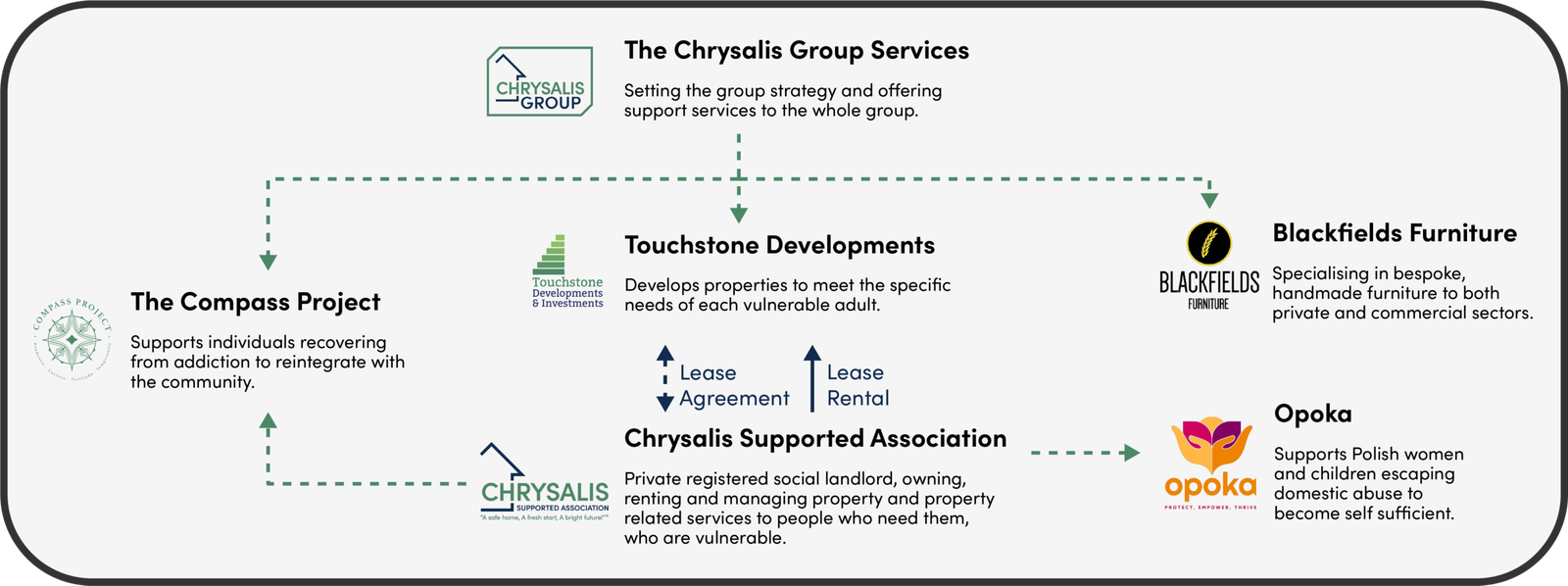
Group Structure
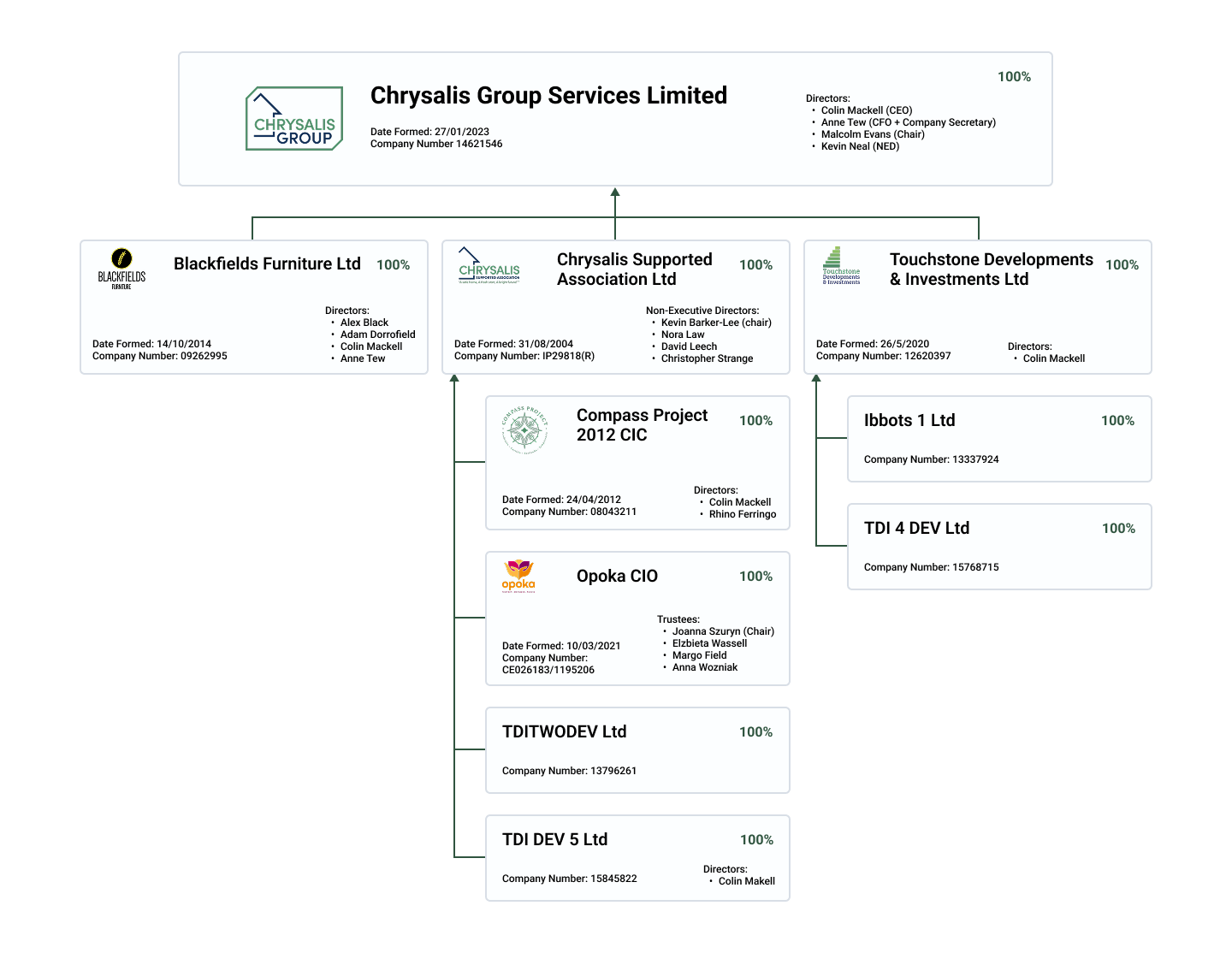
Chrysalis Group Company Ownership Structure
Executive Team

Colin Mackell
Group Chief Executive Officer

Anne Tew
Group Chief Financial Officer & Company Secretary
Management Team

Dan Fern
Group Accountant

Christopher Ball
Marketing Manager
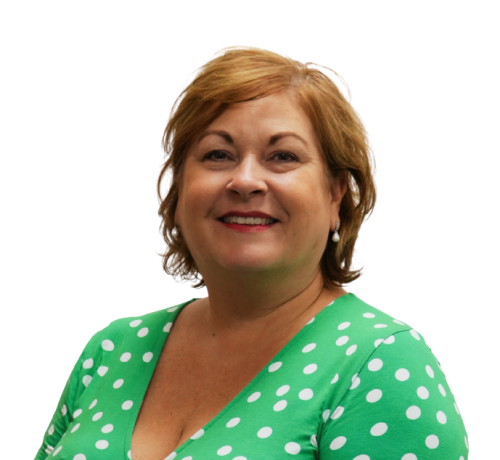
Julia Gay
HR & Quality Co-ordinator